
Nearly 55% of cases of employment discrimination are about workplace retaliation. This is the most common kind of bad behavior at work in the United States. If you face unfair treatment after telling about discrimination or joining in protected activities, you need to know how to sue your old boss for retaliation.
Workplace law is complex, but workers have strong legal protections against bad actions. A claim of retaliation can be a key way to protect your rights and make sure employers follow the law.
Workplace retaliation can happen in many ways, like being fired unfairly or being hurt in your job. Knowing these tricks is the first step to keep your job and protect your rights.
Key Takeaways
- Retaliation affects over 50% of employees who report workplace discrimination
- Legal protections exist for employees experiencing professional retaliation
- Documenting incidents is critical for a successful retaliation claim
- The EEOC provides essential support for workers facing workplace discrimination
- Timely action is key in starting a retaliation lawsuit
Understanding Retaliation in the Workplace
Workplace retaliation is a big problem in employment law. It hurts employee rights and makes work places unfair. It’s important to know about retaliation to keep work places fair.
Definition of Workplace Retaliation
Retaliation happens when an employer gets mad at an employee for doing the right thing. This includes telling on discrimination, helping with investigations, or saying no to illegal tasks.
Common Forms of Retaliation
- Unexpected job termination
- Demotion without cause
- Reduction in work hours
- Negative performance evaluations
- Exclusion from critical projects
- Harassment or hostile work environment
Legal Protections Against Retaliation
Many laws help protect workers from being treated unfairly. The main ones are:
| Law | Protection Scope | Employee Coverage |
|---|---|---|
| Title VII of Civil Rights Act | Discrimination protection | 140 million private sector workers |
| Fair Labor Standards Act | Wage and overtime rights | 43% of private sector employees |
| Americans with Disabilities Act | Disability discrimination prevention | Covers most employers with 15+ employees |
Retaliation claims make up about 40% of all employment discrimination complaints at the Equal Employment Opportunity Commission. This shows how big of a problem it is.
Legal Grounds for a Retaliation Claim
Workers facing unfair treatment or retaliation have strong legal help. It’s key to know these laws when taking action against an employer.
Federal Laws Protecting Employees
Many federal laws protect workers from unfair treatment:
- Title VII of the Civil Rights Act
- Americans with Disabilities Act (ADA)
- Fair Labor Standards Act (FLSA)
- Age Discrimination in Employment Act (ADEA)
State-Specific Legal Safeguards
States also have their own protections. New York has strong laws like the New York State Human Rights Law (NYSHRL) and New York City Human Rights Law (NYCHRL).
Whistleblower Protections
Whistleblower laws protect those who speak up about wrongdoings. The Occupational Safety and Health Administration (OSHA) and other agencies enforce these laws.
| Type of Protection | Key Legal Provisions |
|---|---|
| Federal Protections | Title VII, ADA, Dodd-Frank Act |
| State Protections | NYSHRL, NYCHRL |
| Whistleblower Claims | OSHA, SEC Regulations |
In 2020, the EEOC got about 39,000 retaliation claims. This is 55.8% of all job-related claims. It shows how common unfair treatment is and why knowing your rights is important.
Steps to Take Before Filing a Lawsuit
Dealing with workplace retaliation needs careful planning and detailed records. About 36% of workers face harassment. It’s key to know your legal rights if you’re being retaliated against.
Before going to court, you must gather all the evidence you can. This will help make your case stronger.
Documenting Incidents of Retaliation
Keeping good records is your best defense. Write down all the times you’ve been retaliated against:
- Date and time of each incident
- Names of individuals involved
- Specific details of retaliatory actions
- Potential witnesses
- Copies of relevant communications
Gathering Evidence and Witnesses
Gather strong evidence to back up your claim. This could be:
- Performance reviews
- Email correspondence
- Text messages
- Witness statements
- Internal communication records
Consulting with Legal Counsel
Getting advice from a lawyer is very important. Studies show that workers with lawyers get bigger settlements. They get 2-3 times more than those without lawyers.
| Evidence Type | Importance |
|---|---|
| Written Communications | High – Direct Documentation |
| Witness Statements | Medium – Corroborating Evidence |
| Performance Records | High – Demonstrating Pattern |
Remember, about 90% of successful retaliation claims happen within 90 days of the protected activity. Act fast and wisely to protect your rights.
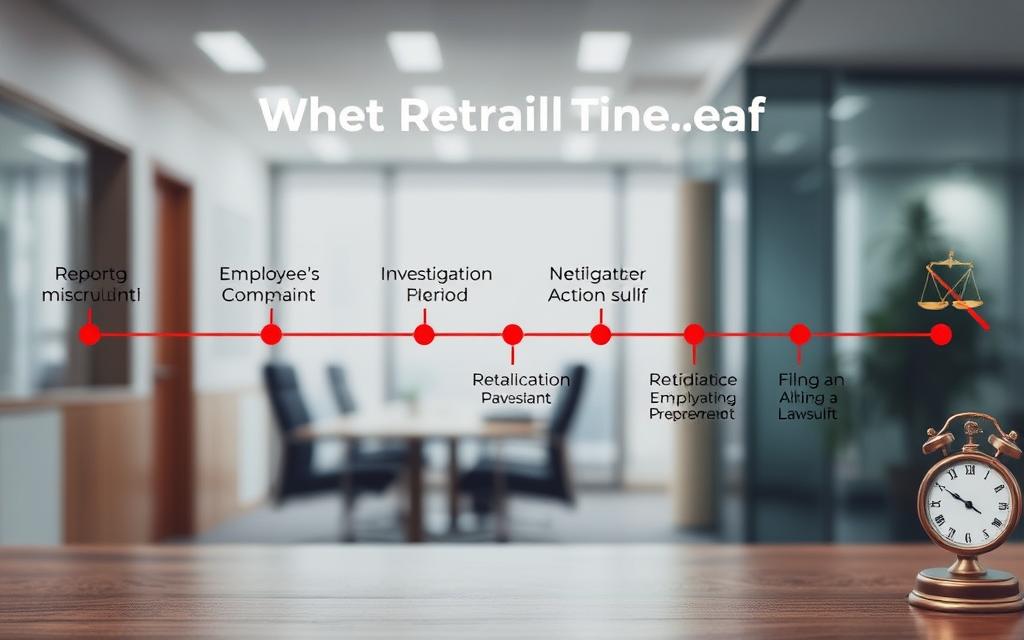
Timing Matters: When to File
Filing retaliation claims needs careful timing and planning. Workers facing retaliation must know when to act to protect their rights.
Statute of Limitations for Retaliation Claims
The time to file a lawsuit is very short. Important deadlines can affect your case:
- Federal claims with the Equal Employment Opportunity Commission (EEOC) must be filed within 180 days of the retaliatory act
- California employees have one year to file discrimination and retaliation complaints with the Department of Fair Employment and Housing (DFEH)
- Different states may have varying time limits for legal action
Importance of Prompt Action
Waiting too long to act on retaliation can hurt your case. Evidence can disappear, memories fade, and important documents may become hard to find.
| Claim Type | Filing Deadline | Potential Consequences of Delay |
|---|---|---|
| EEOC Complaint | 180 days | Loss of legal right to pursue claim |
| California DFEH Complaint | 1 year | Time-barred legal action |
| State-Specific Claims | Varies | Potential case dismissal |
Employment lawyers say to start documenting retaliation right away. Keep emails, witness statements, and performance reviews that support your case.
Filing a Complaint with the EEOC
When you face employment retaliation, knowing the EEOC complaint process is key. Workers have a short time to tackle unfair treatment at work.
Understanding the EEOC’s Role
The EEOC is a vital federal agency that protects workers from unfair treatment. You have up to 300 days to file a claim after facing workplace retaliation. This time frame can vary based on your state’s laws.
Filing a Charge: Step-by-Step Process
- Keep records of all unfair treatment at work
- Reach out to your local EEOC office
- Book an interview using their Public Portal
- Get ready your ID documents
- Fill out a formal complaint of unfair treatment
What to Expect After Filing
After you file a complaint, the EEOC will:
- Look into the unfair treatment at work
- Check if the retaliation claim is true
- Maybe give you a “Right to Sue” letter
For those who are Deaf or Hard of Hearing, the EEOC has a videophone service. Call 1-844-234-5122 for help with workplace discrimination.
Preparing for Your Court Case
Going to court for a retaliation case needs careful planning. If you’re suing your old boss, you must know what to do. This will help you build a strong case.
Winning against your employer takes good evidence and smart planning. Knowing the law well can help you win.
Organizing Your Evidence
Having the right documents is key for a strong case. You’ll need:
- Detailed written records of any bad actions
- Old and new performance reviews
- Important emails about work
- Statements from coworkers
- A timeline of what happened
Understanding the Legal Process
Going to court for a workplace claim has many steps. About 60-70% of these cases settle before trial. The average money won is around $45,000.
| Legal Process Stage | Estimated Duration | Potential Outcome |
|---|---|---|
| Initial Case Evaluation | 1-2 months | Case Acceptance/Rejection |
| Evidence Gathering | 2-4 months | Comprehensive Documentation |
| Settlement Negotiations | 3-6 months | Potential Financial Recovery |
| Potential Trial | 6-24 months | Court Judgment |
Hiring a Competent Attorney
Finding the right lawyer is very important. Good lawyers charge between 33% and 50% of what you win. They can help plan your case and get you more money.
A good lawyer knows the law well. They can help you win your case against your old boss.
Responding to Your Former Employer’s Defense
When you sue your old boss for workplace retaliation, knowing their defenses is key. Bosses use tricky arguments to fight back. It’s up to you to have strong answers ready.
Employers use many ways to fight back against claims of workplace retaliation:
- They might say you didn’t do a good job.
- They claim they had real reasons for firing you.
- They say firing you was part of cutting jobs.
- They doubt if your job loss was because of your actions.
Understanding Employer Defense Tactics
In most states, employers can fire you for almost any reason. But, they can’t fire you because of who you are or what you did.
Preparing an Effective Rebuttal
To fight back against your boss’s arguments, you need solid proof. Here’s what to do:
- Keep all your work reviews.
- Save all emails and messages.
- Get statements from people who saw what happened.
- Make a clear timeline of events.
| Defense Strategy | Employee Counterargument |
|---|---|
| Poor Performance Claim | Provide positive performance reviews |
| Business Necessity Argument | Show selective implementation targeting specific employees |
| Workforce Reduction | Demonstrate disproportionate impact on protected class |
Winning a workplace retaliation case often means showing a clear link between the bad action and your protected activity. It’s wise to collect lots of evidence to help your case against your boss’s defenses.
How Retaliation Lawsuits are Resolved
Understanding how to solve a retaliation lawsuit is key. Workers facing unfair treatment have many ways to fight back.
- Settlements
- Court Trials
- Alternative Dispute Resolutions
Settlements: A Practical Approach
Most lawsuits are settled out of court. This way, both sides can agree on money without a long fight. Settlements offer:
- Quick fixes
- Less legal costs
- Money you can count on
Mediation: An Alternative Resolution Method
Mediation is a team effort to solve disputes. A neutral person helps both sides find common ground.
| Resolution Method | Average Duration | Potential Compensation |
|---|---|---|
| Settlement | 3-6 months | $50,000 – $250,000 |
| Court Trial | 1-3 years | $100,000 – $500,000 |
| Mediation | 1-3 months | $25,000 – $150,000 |
Handling a retaliation lawsuit can be tough. Talking to a good lawyer is a smart move. They can tell you how strong your case is and what might happen.
Factors Influencing Lawsuit Resolution
Many things can change how a lawsuit is solved:
- How strong the evidence is
- How much money you could get
- If the boss wants to talk
- When the unfair action happened
Texas has the most complaints about retaliation. There are strict rules for filing a complaint. Workers can get money for lost pay and emotional harm.
Compensation for Retaliation Claims
Workers who face retaliation at work have legal ways to get money back. Knowing what damages they can get helps protect their rights. It also helps them seek justice.
Types of Damages in a Retaliation Claim
Workers can get different kinds of money back when they file a claim:
- Economic Damages: Money for lost wages and future earnings
- Emotional Distress Damages: Money for the harm to their mind
- Punitive Damages: Money to punish the employer for bad actions
- Money for legal fees and court costs
Calculating Possible Losses
Workplace laws help victims get back money for lost things. How much money they get depends on several things:
| Damage Type | Potential Recovery Range |
|---|---|
| Lost Wages | Money for income lost because of retaliation |
| Front Pay | Money for future income losses |
| Emotional Distress | Up to $50,000-$300,000 |
| Punitive Damages | Varies by case severity |
To win a retaliation case, you need strong evidence. Keep records of what happened, get statements from witnesses, and keep track of all work interactions. This makes your case stronger.
Key Considerations for Compensation
- File complaints within the legal time frame (usually one year)
- Gather all the evidence you can
- Get advice from a good employment lawyer
- Know your rights at work
Even though the amount of money varies, a strong case can help workers get a lot of money back. It can also help them feel better at work.
Case Examples and Precedents
Understanding legal precedents is key in a retaliation case. Workplace retaliation is a big challenge for employee rights. Many landmark cases offer important insights for workers fighting for justice.

Notable Retaliation Lawsuits Defining Modern Employment Rights
Some Supreme Court decisions have changed how we protect against workplace retaliation. The case Thompson v. North American Stainless, LP set important rules for protecting employees. This 8-0 ruling said that anti-retaliation laws cover more than just direct complaints.
Key Legal Insights from Recent Cases
- Kasten v. Saint-Gobain Performance Plastics Corp. protected both oral and written employee complaints
- Pennsylvania State Police v. Suders showed that employees can sue without going through internal procedures
- About 30% of wrongful termination claims are about discrimination
Lessons from Retaliation Case Outcomes
Looking at these cases teaches us important lessons. Employees need to know their rights, keep records of any issues, and understand that protection goes beyond just being fired.
| Case | Key Ruling | Impact on Employment Law |
|---|---|---|
| Thompson v. North American Stainless | Third-party retaliation protection | Expanded anti-retaliation coverage |
| Kasten v. Saint-Gobain | Protected complaint methods | Validated oral and written complaints |
Knowing these precedents helps employees fight workplace retaliation better. Legal protections keep changing, so it’s important to stay up to date with the latest employment law news.
The Emotional Impact of Retaliation
Workplace retaliation can hurt an employee’s mind and heart. It leaves deep scars that go beyond work. People feel very scared and upset when they face unfair treatment at work.
The mind effects of workplace retaliation are big and varied. Studies show that those who face retaliation have big mental health problems:
- 66% of harassment victims face bad outcomes
- 30% more likely to get anxiety and depression
- More stress and burnout from work
Understanding Psychological Consequences
Retaliation can make people feel very down. Victims might feel:
- Less confident in themselves
- Always worried about what others think
- Powerless and alone
Support Resources for Victims
There are many ways to help those hurt by workplace retaliation:
| Resource Type | Description |
|---|---|
| Employee Assistance Programs | Secret counseling and mental health help |
| Professional Counseling | Therapy for work trauma |
| Support Groups | Groups to share stories |
Getting help from experts is key to healing from workplace retaliation. Mental health pros can teach ways to feel better and strong again at work.
Future Implications of Suing for Retaliation
After suing for job retaliation, think about the long-term effects. It’s important to know how it might change your career and how others see you.

Going after a workplace protection claim can really change your job life. Here are some key points:
- 40% of employees who experience retaliation become hesitant to report future workplace issues
- Only 5% of employees successfully litigate retaliation claims in California
- Legal actions can potentially influence future job market opportunities
Effects on Career and Job Market
Winning a lawsuit can make your job search harder. Future bosses might be worried about your legal past. Documented cases show that 25% of employees reporting workplace issues face bad job actions.
Long-Term Consequences for Employers
Employers facing lawsuits might face big problems. They could lose a lot of money and get a bad name.
| Employer Consequence | Potential Impact |
|---|---|
| Financial Penalties | Up to $300,000 in punitive damages |
| Reputational Risk | Negative public perception and possible hiring issues |
| Legal Compliance | Need to change workplace policies |
Knowing these risks helps you decide if suing is right. Always get advice from a lawyer in these tough situations.
Conclusion: Empowering Employees to Take Action
Protecting employee rights needs knowledge, courage, and smart action. In 2020, the Equal Employment Opportunity Commission (EEOC) got 37,632 retaliation complaints. This is almost 56% of all workplace complaints. It shows how important it is to know your legal protections.
The Importance of Knowing Your Rights
Workplace retaliation can hurt careers and personal well-being. Employees must know their legal protections and when their rights are broken. Retaliation legal advice helps a lot in dealing with tough work issues.
- Understand federal and state employment laws
- Document possible instances of workplace retaliation
- Recognize protected activities
- Know your legal options
Encouragement to Seek Legal Counsel
Getting professional legal counsel is key when facing workplace retaliation. Employment law experts offer:
- Full case review
- Smart advice
- Help in legal fights
Remember, your professional honor and career path are worth fighting for. Taking smart, informed steps can protect your rights and future.
Additional Resources for Employees
Understanding workplace protection is key. Employees can find many resources to learn about their rights. The U.S. Equal Employment Opportunity Commission (EEOC) is a great place to start. They have offices all over the country to help with discrimination issues.
Groups like the National Employment Lawyers Association help a lot. They have lawyers who know a lot about work rights. The American Civil Liberties Union (ACLU) also has lots of help for workers facing discrimination.
Useful Contacts and Organizations
There are many places where employees can get help. The EEOC can help you find local agencies. State labor departments also offer advice. Legal aid services give free or low-cost help to understand work rights.
Further Reading on Employment Law
Learning more about employment law is important. The Department of Labor has great publications. The National Labor Relations Board has guides too. Books like “The Employee Rights Handbook” by Steven Mitchell Sack are also helpful.
Online sites like NOLO.com have easy-to-understand legal guides. They make complex work rights easy to understand.